When it comes to watersports, throttle position is more than a number on the speedometer. Boat speed shapes the size, steepness and firmness of the wake—and finding the right pace can make the difference between fighting the boat and finding the sweet spot.
The ideal speed varies with the rider, boat, ballast, propeller, water conditions and equipment. Still, these ranges provide a useful starting point.
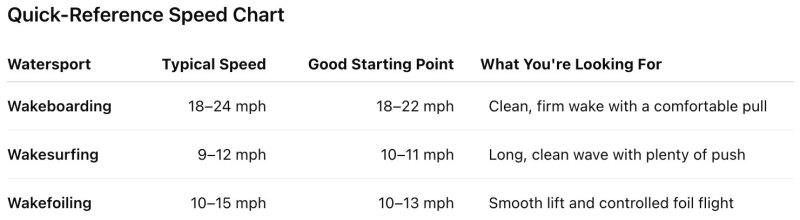
Wakeboarding: 18 to 24 MPH
Wakeboarding generally calls for the highest speed of the three sports. Most recreational riders will find a good starting point between 18 and 22 mph, while experienced riders may prefer 22 to 24 mph or more.
Speed affects the wake in several ways. Running faster generally lengthens the transition and changes the shape of the wake, while ballast and boat setup determine its size and firmness. Beginners often benefit from the lower end of the range because a slower boat gives them more time to get comfortable behind the boat.
For younger or smaller riders, don’t be afraid to slow down. The goal is a manageable wake and a comfortable pull, not a particular number on the GPS.
Wakesurfing: 9 to 12 MPH
Wakesurfing is a different game. Because the rider is not directly attached to the boat, the boat needs to generate a relatively large, clean, surfable wave at comparatively low speed.
A typical wakesurf setup works in the neighborhood of 9 to 12 mph, with many boats finding their sweet spot around 10 to 11 mph. Slower speeds can produce a shorter, less developed wave, while excessive speed can stretch the wave and make it harder to stay in the pocket.
Boat attitude matters tremendously. Ballast, surf tabs and wake-shaping systems can alter the wave as much as a change in speed. The driver should make small speed adjustments while the rider communicates whether the wave needs more push, length or height.
And because the rider is operating without a towrope, wakesurfing should be performed well clear of the boat’s stern and propeller. Follow the boat manufacturer’s and applicable boating-safety guidance.
Wakefoiling: 10 to 15 MPH
Wakefoiling occupies the middle ground. A foil generates lift beneath the board, allowing the rider to rise above the water and glide with surprisingly little resistance. That means wakefoilers typically need less boat speed than wakeboarders.
A useful starting range is about 10 to 15 mph, although foil design and rider skill can shift that considerably. Beginners often benefit from a slower, controlled pace, while experienced riders may prefer additional speed to generate more lift and distance behind the boat.
Unlike wakesurfing, the objective isn’t necessarily to create the biggest possible wave. A wakefoil rider can use the boat’s wake as a source of lift, but the foil itself does much of the work. Once the rider is comfortable, the boat can often run at a speed that produces a manageable wake without creating unnecessary turbulence.
Read Next: Foiling Tips With Sam Langley
Set the Speed, Then Fine-Tune
The numbers on the speedometer are starting points, not commandments. GPS-based speed is preferable to relying solely on the boat’s analog speedometer, and consistency matters when learning or practicing.
For all three sports, use a competent driver who can maintain a steady heading and speed. Make adjustments in small increments—typically 0.5 to 1 mph—rather than making dramatic throttle changes. Water conditions, rider weight, rope length, ballast and the boat’s hull design can all change the ideal setting.
The best speed is ultimately the one that produces the desired ride while keeping the rider comfortable and in control. Set the throttle, watch the rider and wake, and let the water tell you when you’ve found the sweet spot.