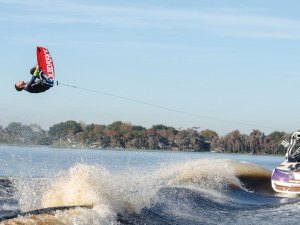
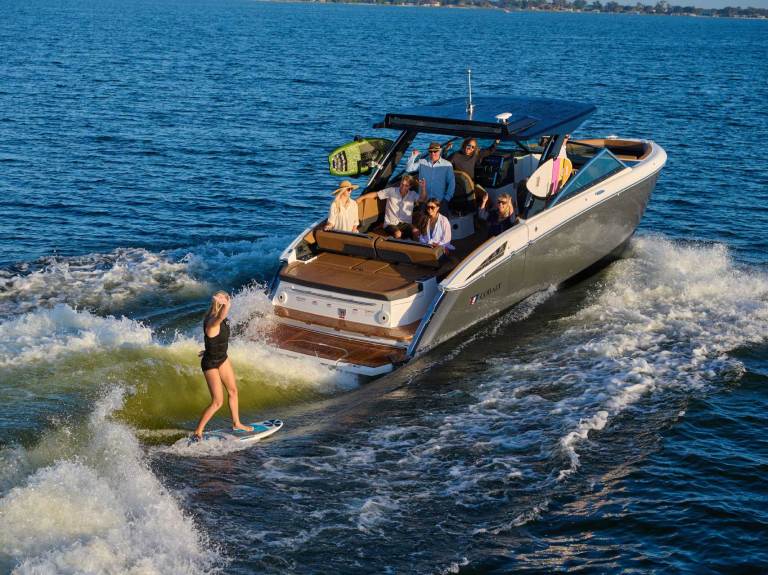
(Footage of Gunner Daft shot in 2023 during a photoshoot with Montara Boats.)
A bad wakeboarding landing can wreck a knee in an instant—but the problem may start several inches lower. When your feet and ankles fail to provide a stable foundation, the forces generated by a hard landing or unexpected edge catch can travel up the leg, putting your knees at risk.
Strengthening the muscles around your knees is essential to preventing wakeboarding injuries. But even the best knee-strengthening routine can fall short if you overlook a weak link farther down the chain: your ankles and feet.
An ankle sprain can leave ligaments stretched and the joint less stable, increasing the risk of recurrent sprains. When the foot loses support, its arch may collapse excessively, causing overpronation. That inward rolling motion can contribute to internal rotation of the tibia, or shinbone, and altered knee alignment.
Under ordinary conditions, the effect may be barely noticeable. Wakeboarding, however, places substantial forces on the lower extremities, particularly during hard landings, unexpected edge catches and awkward falls. Under those loads, poor lower-limb stability can contribute to knee injuries, including damage to the meniscus, medial collateral ligament (MCL) or anterior cruciate ligament (ACL).
Build stability from the ground up. Incorporate ankle-strengthening and balance exercises into your training routine. Drawing the alphabet in the air with your foot helps develop ankle mobility and control. Calf raises strengthen the muscles supporting the ankle, while balance exercises on a stable surface—and, as your ability improves, an appropriate balance trainer—challenge the muscles responsible for joint stability.
If excessive arch collapse is a concern, supportive footwear or a properly fitted orthotic may also help. Some riders use athletic tape to provide temporary support beneath the arch, although taping is not a substitute for rehabilitation or an assessment by a qualified health professional.
Read Next: How to Prevent Wakeboarding Injuries
To try a simple arch-support taping technique, use two pieces of athletic tape, each approximately 6 to 8 inches long. With your foot relaxed in a neutral position and not bearing weight, place the first strip across the front of the ankle, carry it beneath the foot and secure it back onto itself. Apply the second strip beginning beneath the joint at the base of the big toe, extending it under the foot and anchoring it back onto itself.
Keep the tape snug but never tight enough to restrict circulation or cause numbness, tingling or discomfort. Check the fit before riding, and remove the tape if irritation or other symptoms develop.
The takeaway? Don’t focus on the knees alone. Wakeboarding demands coordinated strength and stability throughout the lower body, and healthy ankles and well-supported feet are important parts of that equation.